Acquiring a dental practice is not just a financial or operational transaction. It is also a technology transition. The practice may come with different workstations, imaging equipment, network configurations, phone systems, user accounts, security gaps, backup processes, software versions, and vendor relationships. If those details are not reviewed early, the acquisition can create avoidable delays, patient flow disruptions, cybersecurity exposure, and added cost after closing.
For DSOs and growing dental groups, IT due diligence helps answer a practical question: can this location be integrated into the organization’s standards without slowing the practice down? The goal is not simply to identify every technical issue, but to understand what must be remediated before integration, what can wait until after go-live, and what could affect staff, patients, billing, compliance, or revenue continuity.
Why IT Due Diligence Matters Before Integration
Many acquired practices have technology environments that evolved over time. A location may have a stable team and healthy production, but the systems behind the scenes may be inconsistent, undocumented, unsupported, or difficult to scale. That becomes a problem when the acquiring organization tries to standardize software, security, support, reporting, communications, and workflows across locations.
Dental IT due diligence gives leadership a clearer view of inherited risk before the transition becomes urgent. It helps uncover aging equipment, unsupported operating systems, gaps in backup coverage, weak access controls, unreliable internet, unknown administrator accounts, imaging compatibility issues, and PMS workflow considerations that may affect the integration plan.
What Should Be Reviewed During a Dental IT Assessment?
A strong acquisition IT review should cover both infrastructure and dental workflow. Traditional IT checklists often miss the systems that keep a dental office running, including imaging devices, operatory workstations, practice management software, claims workflows, treatment planning tools, sensors, scanners, printers, call systems, and vendor-supported applications.
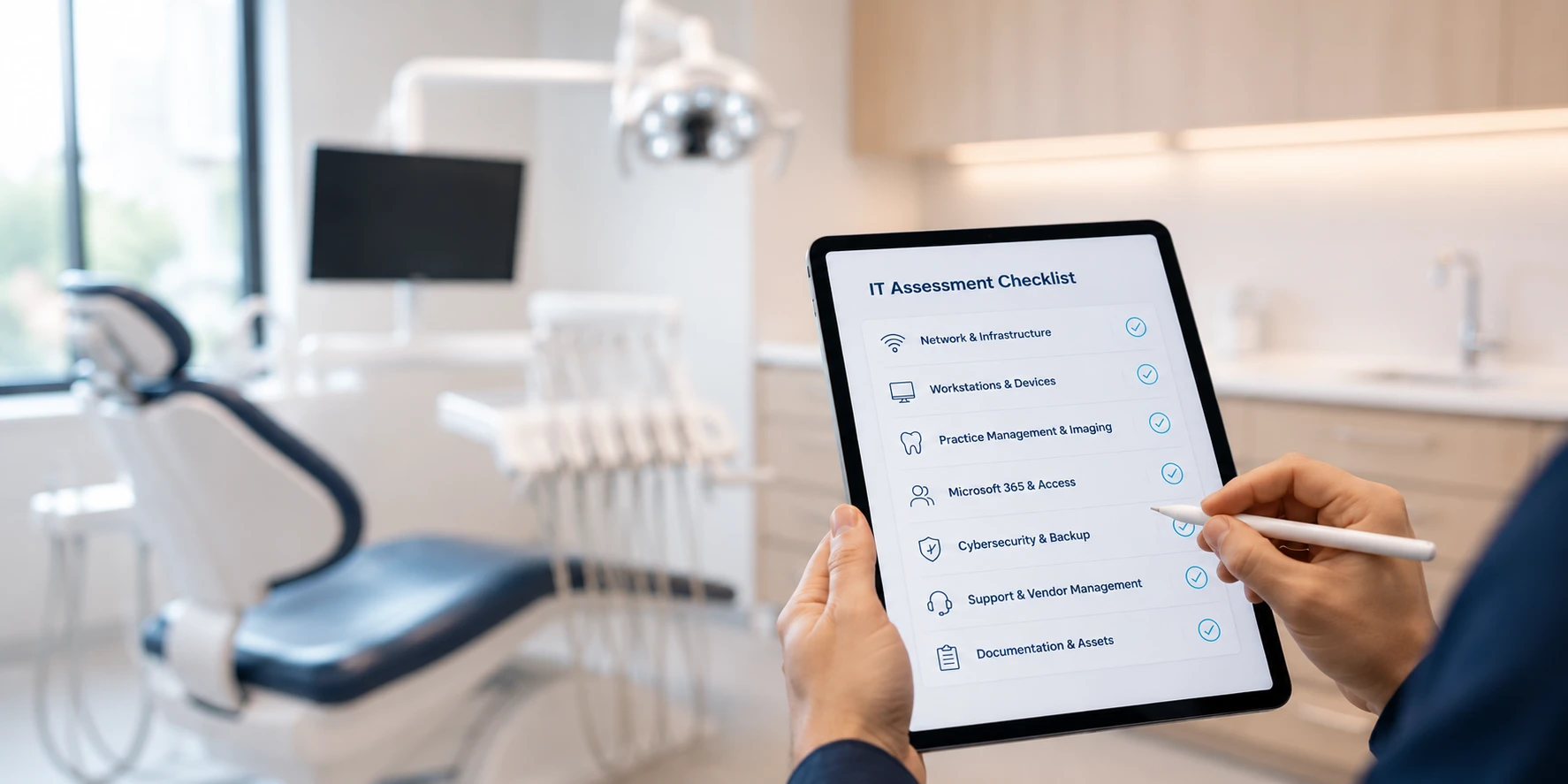
A comprehensive acquisition IT assessment should include:
- Network & Infrastructure — firewalls, switches, wireless coverage, cabling, and internet redundancy.
- Workstations & Clinical Devices — servers, operating systems, printers, scanners, phones, and clinical devices.
- Practice Management & Imaging — PMS, imaging, integrations, software versions, licensing, and vendor dependencies.
- Microsoft 365 & User Access — email, user access, MFA, shared mailboxes, and former employee accounts.
- Cybersecurity & Business Continuity — backup coverage, disaster recovery processes, cybersecurity tools, patching, and endpoint protection.
- Support & Vendor Management — support history, recurring issues, escalation paths, and vendor contacts.
- Documentation & Technology Assets — admin credentials, warranties, renewal dates, and technology ownership.
Common Acquisition IT Risks
One of the biggest risks is assuming the acquired location can be quickly absorbed into the parent organization’s standards without remediation. In reality, the practice may have aging workstations, inconsistent naming conventions, local administrator access, limited documentation, unsupported software, or vendor contracts that do not align with the group’s operating model.
Another common issue is PMS and imaging complexity. Even when a location uses a familiar platform, the configuration, workflows, templates, integrations, and user habits may vary significantly. That can make training, support, reporting, and standardization more challenging than expected.
Security and access are also critical. User accounts, former employee access, shared passwords, exposed remote access, weak MFA adoption, and unclear backup status can all create risk during a transition. These issues are easier to address before go-live than after the newly acquired team is already working within the broader organization’s environment.
How to Prioritize Remediation
Not every issue needs to be fixed at the same time. A practical acquisition IT plan should separate findings into three categories: items that must be resolved before integration, items that should be completed during transition, and items that can be addressed after the location is stable.
- Pre-integration priorities: security, access, backups, connectivity, unsupported systems, and anything that could stop patient care.
- Transition priorities: workstation readiness, PMS and imaging alignment, vendor coordination, user onboarding, phones, email, and documentation.
- Post-integration priorities: workflow refinement, staff training, standardization, managed services, monitoring, and long-term technology planning.
Where Thinc Forward Fits
Thinc Forward helps dental organizations assess, remediate, deploy, and support technology across acquisitions, de novos, expansions, and improvement projects. For acquisition work, that means helping leadership understand inherited systems, identify risk, standardize the environment, coordinate vendors, and support the location before, during, and after integration.
The result is a more predictable transition. The practice can keep serving patients, leadership can reduce technical surprises, and newly acquired locations can be integrated more consistently.
Planning an Acquisition? Start With the Technology Baseline
Every successful integration starts with a clear understanding of the technology you’re inheriting. A structured assessment helps identify risk, prioritize remediation, and create a roadmap for a smoother transition.
Download our Multi-Location Dental IT Integration Checklist to evaluate technology readiness, organize your findings, and support a more consistent integration process.
Need help evaluating an acquisition or planning an integration?

Dental acquisition IT support helps a DSO or dental group assess, transition, standardize, and support the technology environment of a newly acquired practice. It can include infrastructure review, PMS and imaging considerations, user access, cybersecurity, vendor coordination, and post-integration support.
IT should be reviewed as early as possible, ideally before the integration timeline is finalized. Early review helps uncover risks that may affect go-live, security, cost, staff readiness, and patient flow.
Common issues include aging workstations, weak documentation, inconsistent backups, unsupported software, unclear administrator access, recurring PMS or imaging problems, vendor dependencies, and network or cybersecurity gaps.